Online football information has become increasingly detailed. Fans can access team form, injuries, schedules, statistics, and market movements before a match begins. This amount of data can be useful, but it can also encourage readers to focus too heavily on one indicator.
Football remains unpredictable. Odds and match analysis are best understood as information reflecting expectations and market conditions, not guarantees of what will happen on the pitch.
Start with kèo trực tuyến and Basic Match Information

When researching kèo trực tuyến, readers should first establish the basic context of the fixture.
They should identify the competition, venue, kickoff time, league position, and recent form of both teams.
A domestic league game may have a different strategic context from a cup semifinal or continental match.
Understanding the situation around the fixture makes later statistics easier to interpret.
Compare Recent Form Carefully
A sequence of wins or losses can provide useful information, but opponent quality matters.
Five victories against struggling teams do not necessarily indicate the same performance level as strong results against title contenders.
Readers should also separate home and away records.
Some teams have dramatically different results depending on venue, tactical approach, and travel requirements.
Use Soi kèo nhà cái as One Analytical Source

Content about Soi kèo nhà cái should be treated as analysis rather than certainty.
A useful preview explains the evidence behind an interpretation. This may include injuries, tactical matchups, recent performances, scheduling, or expected lineups.
Readers should be cautious when an article presents a predicted result as guaranteed.
Football contains too many uncertain variables for any responsible analysis to promise a particular outcome.
Understand What Odds Represent

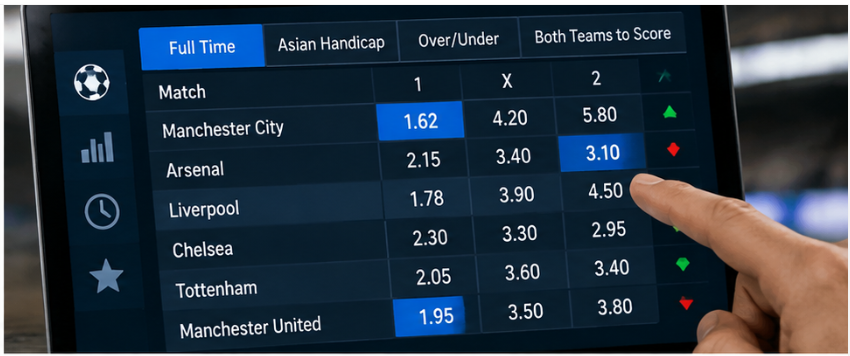
Odds can reflect market expectations, available information, and adjustments over time.
They do not prove what will happen.
A shorter price does not mean an outcome is certain, just as a longer price does not mean an outcome is impossible.
Readers should separate the market’s implied expectations from the actual result, which remains unknown until the match is played.
Check Injuries and Suspensions
Player availability can influence tactical plans and team quality.
The absence of a goalkeeper, central defender, creative midfielder, or leading striker may be particularly significant.
However, the effect depends on squad depth and the quality of replacements.
Confirmed absences should carry more weight than rumors circulating several days before kickoff.
Analyze Tactical Matchups
Two teams with similar league positions can produce very different performances depending on how their styles interact.
A high defensive line may be vulnerable to fast attackers. A possession-heavy team can struggle against an organized low block.
Set-piece ability, pressing, width, and midfield structure can also influence the match.
These details often provide more context than simple win-loss records.
Review Goal Statistics Carefully
Goals scored and conceded are useful starting points, but averages can be distorted by unusual matches.
A team scoring five goals in one fixture may have relatively modest attacking output across the remaining games.
Readers should therefore examine trends over several matches and consider how chances are being created.
The same principle applies to defensive statistics.
Consider the Schedule
Fixture congestion can influence rotation and recovery.
A team playing several competitions may have only a few days between matches, while its opponent has had a full week to prepare.
This does not automatically determine performance.
Squad depth, travel, and previous playing minutes should also be considered.
Be Cautious with Head-to-Head Data
Historical meetings are popular but can quickly become outdated.
Managers change, players move, and tactical systems evolve.
A match played several seasons ago may tell readers little about the current teams.
Recent meetings can provide context, but they should not override more current information about form and personnel.
Wait for Official Lineups
Expected lineups can change shortly before kickoff.
A late injury, illness, or tactical decision may alter the formation significantly.
Official starting teams therefore provide one of the most valuable final pieces of pre-match information.
Readers should update earlier analysis after lineups are confirmed.
Separate Analysis from Financial Decisions
Understanding a football match and deciding to risk money are different activities.
Even detailed analysis cannot remove uncertainty.
Anyone participating in real-money wagering should use only money they can afford to lose and should not increase spending to recover previous losses.
No statistical model or preview can guarantee profit.
Conclusion
Online football odds and match analysis become more useful when readers place them within a broader sporting context. Recent form, opponent quality, injuries, tactics, scheduling, and confirmed lineups all contribute useful information.
The key is to distinguish evidence from prediction. Odds represent expectations rather than certainty, while previews provide interpretations rather than guaranteed outcomes. A balanced approach helps readers understand football information without treating uncertainty as something that can be completely eliminated.