Digital entertainment platforms have become easy to access on both mobile and desktop devices. This convenience allows users to explore games quickly, but it also makes responsible habits increasingly important.
Before using any platform, users should understand its terms, account requirements, security practices, and the nature of the games being offered. If money is involved, local regulations and personal financial limits become particularly important.
The goal should be to keep entertainment controlled, optional, and separate from essential financial responsibilities.
Understanding 789CLUB Before Registration

Users researching 789CLUB should review the information available about the platform before creating an account.
Terms of service, age requirements, privacy policies, and transaction rules should be examined carefully.
If real-money activities are available, users should independently verify whether participation is permitted in their jurisdiction.
Website accessibility does not automatically mean legal availability in every location.
Users should also be cautious about claims made by third-party advertisers or social-media accounts.
Official terms are more reliable than informal promises.
Creating a Secure Account

A unique password is an important first step.
Users should avoid reusing passwords from email, banking, or social-media services.
If one account is compromised, reused credentials can expose other services.
Verification codes should never be shared.
Users should also check the website address before logging in, particularly if they arrived through a link sent by message.
Phishing websites can closely imitate legitimate interfaces.
Exploring 789 Responsibly
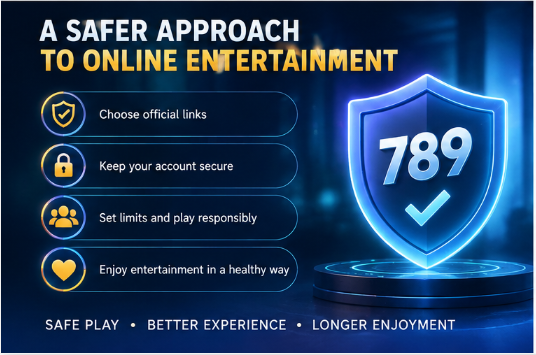
When visiting 789, users should learn the rules of each game before participating.
Different games can involve different levels of chance and decision-making.
A player may be able to make strategic choices in some games, but no strategy should be assumed to eliminate uncertainty completely.
If practice modes are available, they can be useful for understanding controls and rules without financial pressure.
New users should prioritize learning rather than speed.
Understanding Random Outcomes
Randomness is central to many online games.
Past results may look like patterns, but short sequences can occur naturally.
A series of losses does not mean a win is guaranteed soon.
Likewise, a series of wins does not mean future outcomes will remain favorable.
This is important because users can otherwise become overconfident or feel compelled to continue.
Realistic expectations reduce the temptation to treat entertainment as a predictable financial system.
Setting Spending Limits
For any real-money activity, users should decide on a maximum entertainment budget before beginning.
This amount should be completely separate from rent, food, bills, savings, and debt payments.
Once the limit is reached, it should not be increased during the session.
Changing the limit after losing defeats the purpose of setting one.
Tracking total spending by week or month can also reveal patterns that individual transactions may hide.
Avoiding Loss Recovery Behavior
Trying to recover losses immediately can lead to increasingly risky decisions.
Users may raise stakes or extend sessions because they want to return to an earlier balance.
However, previous losses do not make later outcomes more favorable.
Taking a break can interrupt this cycle.
A decision to stop should be respected even when the user feels that “one more round” might change the situation.
Managing Session Length
Time limits are useful even for non-financial games.
Continuous availability can make digital entertainment feel endless.
Users can decide in advance how long a session will last.
Device-based screen-time controls can provide additional reminders.
If gaming starts to replace sleep, exercise, work, or social activities, reducing usage may be appropriate.
Reading Bonus Conditions
Promotions should be evaluated based on their full terms rather than the largest number shown in an advertisement.
Users should check eligibility, expiry dates, minimum requirements, excluded activities, and withdrawal conditions.
A bonus should not justify spending beyond the predetermined entertainment budget.
Claims of guaranteed profit should be treated skeptically because promotional conditions do not remove random risk.
Protecting Personal Information
Users should avoid sharing account details with anyone claiming to offer special access or account assistance.
Passwords and one-time verification codes should remain private.
Public devices should be used cautiously, and saving credentials in a shared browser should be avoided.
Users should also periodically review their account activity and payment history.
Unexpected transactions should be investigated promptly.
Conclusion
Using an online entertainment platform responsibly involves more than understanding how individual games work.
Users should review terms, verify local legal requirements, secure their account, and recognize that many outcomes are random.
A fixed spending limit and a clear time boundary can help maintain control.
Promotions should be read carefully, and losses should never be treated as a reason to increase spending.
The most sustainable approach is to regard online gaming as optional entertainment rather than a source of guaranteed income.